David Morago
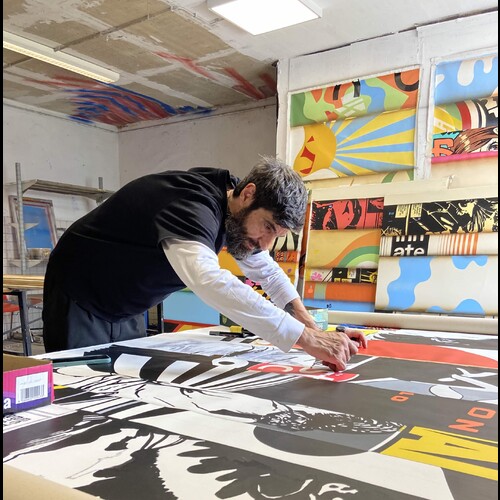
Spanish artist David Morago, born in Madrid, began his professional career in the late 1990s, gradually establishing an international presence through a body of work deeply rooted in the natural world. For many years, flora and fauna formed the core of his artistic practice, approached from an almost academic perspective and executed with remarkable technical virtuosity. This early period is distinguished by meticulous craftsmanship, creating a visual universe in which organic forms take centre stage without artifice.
In 2025, Morago joined Art Support, SOLO Contemporary's international contemporary art programme based in Madrid. This marked the beginning of a new body of work entitled Glitch, in which the artist leaves behind the calm precision of naturalistic observation to enter a territory of increasing formal reduction, where representation gives way to the construction of the image itself. Influenced by the visual language of manga and anime, this series places colour at the centre of the composition, while forms—typographic fragments, interrupted images, and signs that seem to hover between meaning and silence—remain deliberately open to interpretation. This conceptual shift is accompanied by an equally significant technical exploration. Airbrushing, spray paint, and pigment transfer become integral elements of Morago's artistic vocabulary. Wood initially serves as his primary support, but he soon turns to canvas, where he discovers a different way of working—one that allows for greater gestural freedom and a lightness that encourages a more spontaneous and dynamic form of painting. The works developed during this new phase have evolved considerably over time. The earliest compositions, flatter in character, recall the spines of books arranged across the shelves of a library. By contrast, the works presented in Zwischenzeit reveal a clear Bauhaus influence. Here, line assumes a more prominent role, forms are progressively distilled, and chromatic contrasts acquire a visual intensity reminiscent of Josef Albers' investigations into colour and perception.
Four months in residence at Urban Spree, immersed in a cultural environment radically different from that of Spain, have left a decisive mark on this process. The light, the urban landscape, and the visual culture of the city have reshaped the artist's gaze, giving rise to a body of work that would have been difficult to conceive elsewhere. Yet Zwischenzeit is not merely about a change of place; it is also about a state of transition. The works gathered in this exhibition belong to that indeterminate space—a liminal realm where our minds occasionally come to rest. What we witness is not a transformation already accomplished, but the very moment in which it unfolds. Finished works suspended in the abstraction of time.